| Output Section - Stored Energy or QL |
|
| Output Section - Stored Energy or QL |
|
|
|
||
| How
much power a filter can handle before break-down occurs is dependent on
factors like pressure, temperature, resonator geometry, unloaded Q, return
loss, topology, frequency, signal dynamics (modulation, duty-cycle, prf)
etc. The stored energy of a resonator is proportional to the square of the peak electric field strength of the resonator. |
||
|
||
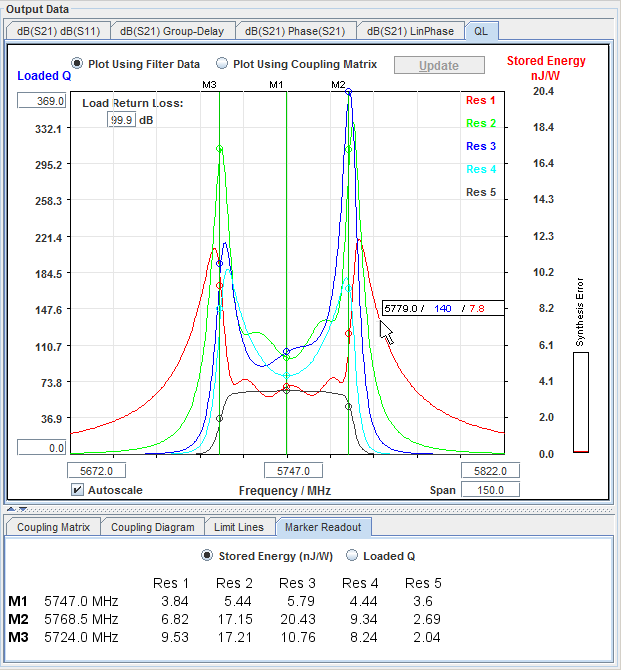 |
Loaded
Q and stored energy (10-9J/Watt) for each resonator in the
filter.
|
|
|
|
||
|
|
||
| More
information on power handling analysis of Rf filters can be found in GWT's
Microwave Journal Article [6]
and in the CMS web site's example. |
||
| The graphs can be arranged by changing the values on the axes. | ||
© 2017, Guided Wave Technology - All Rights Reserved